

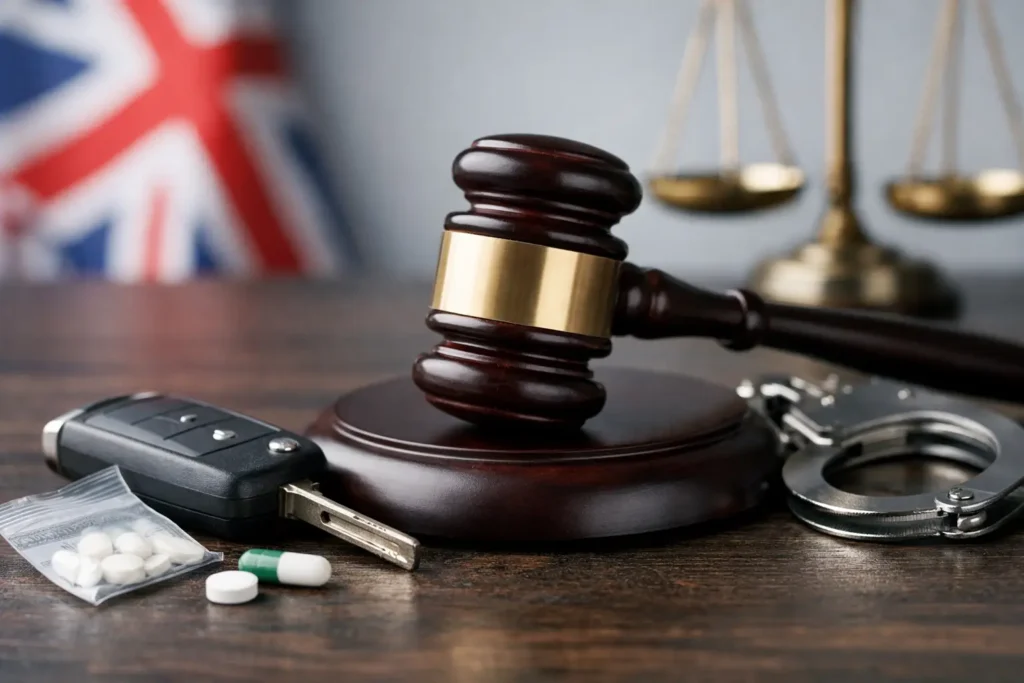
A charge for drug driving can unravel your routine very quickly. Your licence, your job, your insurance and, in some cases, your freedom may all be at risk. If you are worried about the sentence for drug driving, the first thing to understand is that there is no single standard outcome. The court looks at the offence itself, the level of impairment or drug found, your driving, your record and the wider impact of the case.
What sentence for drug driving can the court impose?
In England and Wales, drug driving is treated as a serious motoring offence. A conviction can lead to a mandatory driving disqualification for at least 12 months, an unlimited fine, and in more serious cases a community order or imprisonment of up to six months. The court may also order you to take an extended re-test before you can drive again.
That is the legal framework, but real cases vary. Someone stopped at a roadside check with no collision, no poor driving and strong mitigation may face a very different result from someone involved in an accident, carrying passengers, or driving for work while significantly over the legal limit.
There are usually two types of drug driving allegation. The first is driving or attempting to drive with a specified controlled drug above the legal limit. The second is driving while unfit through drugs. The first often turns on blood results and procedure. The second can involve evidence of impairment, police observations and witness accounts. The sentence for drug driving can be affected by which allegation is pursued and what evidence the prosecution relies on.
How sentencing works in drug driving cases
Magistrates and judges do not sentence by guesswork. They follow sentencing guidelines, which are designed to make outcomes more consistent while still allowing the court to reflect the facts of an individual case.
The court usually begins by assessing seriousness. It will look at the level of risk created, whether there was actual harm, and whether there were features that make the offence worse or less serious. Driving a short distance with no passengers and no poor driving is not viewed the same way as driving at speed, ignoring traffic signals or causing a collision.
The court then considers aggravating and mitigating factors. This is where legal representation can make a real difference. A sentence is not decided solely by the charge on paper. It is shaped by how the facts are presented, what supporting evidence is available, and whether there is a clear picture of your personal circumstances.
Aggravating factors the court may consider
Some features will make the case more serious. These often include previous motoring convictions, especially for drink or drug driving, evidence of dangerous or erratic driving, carrying passengers, being involved in an accident, or committing another offence at the same time. If the offence took place while working as a professional driver, the court may also regard the breach as particularly serious.
Refusing to engage with the process or showing no insight into the offence can also work against you. Courts expect defendants to understand the risk created by driving after taking drugs, even where there was no collision.
Mitigating factors that may reduce the penalty
Mitigation does not erase the offence, but it can help limit the damage. A genuine early guilty plea, previous good character, co-operation with the police, clear remorse and evidence that the offence was out of character can all assist. So can strong personal mitigation, such as the impact of a ban on caring responsibilities, employment or dependent family members.
There are limits here. Hardship alone does not prevent a disqualification, because a driving ban is usually mandatory. However, well-prepared mitigation can influence the length of the ban, the level of fine, whether a community order is imposed and how the court views the overall seriousness of the case.
The most common penalties after conviction
For many people, the immediate concern is whether they will go to prison. In straightforward first-offence cases with no collision and no especially bad driving, imprisonment is not the usual outcome. More often, the sentence for drug driving involves disqualification and a financial penalty. But that should not create false confidence. A ban of at least a year can be life-changing.
A fine is commonly based on your income, and the court can also order prosecution costs and a victim surcharge. For some defendants, the financial consequences continue long after the sentence. Insurance premiums can increase sharply, and some occupations become difficult or impossible to continue.
Where the case is more serious, the court may move beyond a fine. A community order can include unpaid work, a curfew or rehabilitation requirements. In the most serious cases, particularly where there was very poor driving, a collision, repeat offending or clear disregard for public safety, custody becomes a real possibility.
Why the evidence matters so much
Not every charge leads to a conviction. Drug driving cases often look simple from the outside, but they can involve technical issues. The prosecution must prove the offence properly. That may involve roadside procedure, arrest and detention issues, blood sample handling, continuity of evidence, timing, and whether the correct legal process was followed.
Prescription medication can also complicate matters. Some people assume that having a lawful prescription automatically protects them. It does not. Certain prescribed drugs can still lead to prosecution if you are above the specified limit or genuinely unfit to drive. At the same time, there may be a statutory medical defence in some circumstances, or there may be evidential weaknesses that need to be examined carefully.
This is one reason why early advice is so important. Before focusing only on the likely sentence for drug driving, it is vital to assess whether the allegation can be challenged at all. A proper review of the evidence may identify issues that are not obvious from the charge sheet.
Guilty plea or defence – what should you do?
This depends entirely on the facts. If the evidence is strong and there is no realistic defence, an early guilty plea can reduce the sentence. In the magistrates’ court, that reduction can be significant, especially on the financial penalty. It can also help present you as someone taking responsibility at an early stage.
But pleading guilty too quickly can be a mistake if the evidence has not been tested. Some defendants assume they have no option because the police say they failed a test. That is not always the end of the matter. Procedure, timing, the type of charge and the reliability of the evidence all need proper review.
The right approach is an informed one. A solicitor should look at the prosecution case, explain whether there is a viable defence, and then advise on the best route to protect your position. That may mean fighting the allegation or, where conviction is likely, building the strongest possible mitigation.
The wider consequences beyond the court sentence
The formal sentence is only part of the picture. A drug driving conviction will appear on your driving record and can affect employment, especially where driving is part of your role. Some employers in regulated sectors may view the offence as a conduct issue. Travel can also become more complicated in certain circumstances, depending on the country and the nature of the conviction.
For many clients, the practical impact is what hurts most. School runs, commuting, caring for relatives and keeping a business running can all become much harder once a ban is imposed. That is why every stage matters, from the police station to the first hearing and sentence.
Getting legal help early can change the outcome
The strongest cases are usually built early. That means obtaining disclosure, checking procedure, preserving mitigation evidence and making sure your personal circumstances are put before the court properly. It also means avoiding casual admissions or assumptions that may damage your defence.
At Cooper Hall Solicitors, this type of case is approached with the seriousness it deserves. Drug driving allegations are not minor administrative problems. They are criminal matters with immediate and lasting consequences, and they require clear advice, careful preparation and firm representation.
If you are facing an investigation or court proceedings, the key is not to guess what sentence for drug driving you might receive and hope for the best. Get advice on the evidence, understand your options and take control of the case as early as possible. The right action now can protect far more than your licence.